The Algorithm as Signal
The feed isn’t merely showing us what we are thinking about.
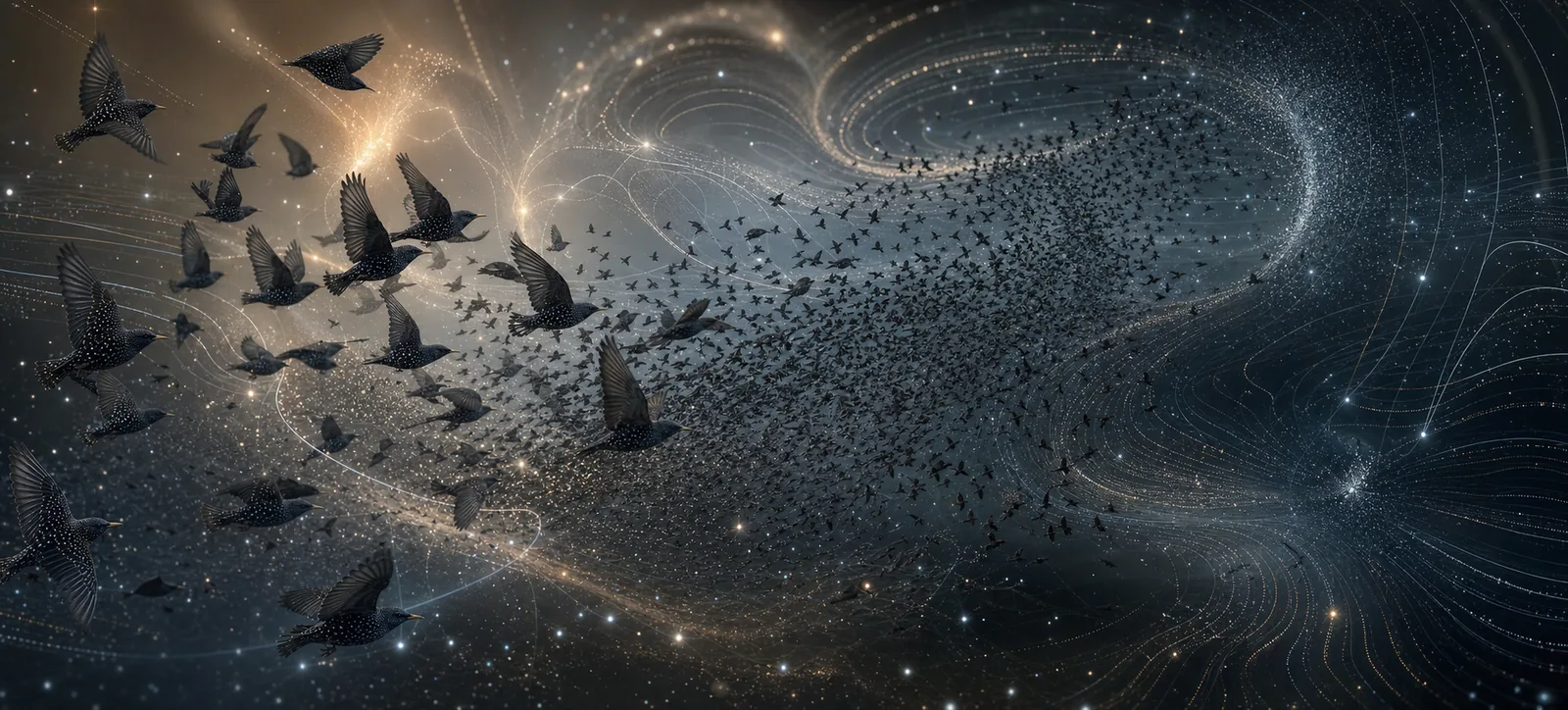
It is showing us where we are flocking, and who we are moving with.
The concept of the distributed self is, on its own, not new at all. What I’m sharing here are my observations from algorithmic interactions over many years. The implications of this line of thinking are enormous for our way of relating to one another, to our own thoughts, and to our shared ecology. That includes the ecology of ideas.
The actual mechanisms behind this are still a delightful mystery to me, but I have a few theories on it, and I would love to hear others.
I tend to believe that nothing can ever be truly “solved” because observing and perceiving more deeply actually generates new possibilities to discover. I think this functions like a kind of “generativity failsafe”…but I wouldn’t want to say I’ve solved something.
Whether on TikTok, LinkedIn, or other online spaces, I’ve observed a fascinating phenomenon.
Topics, objects, people, and questions routinely show up in my feeds directly after I am holding them in my awareness.
I have tested this many times, often unintentionally. Some become impossible to ignore, like thinking of a TikTok friend’s face after not seeing their videos for a while, and the next scroll is one of their videos. Other times, I might be mid-writing, and I pause to refresh my LinkedIn feed, and what is reflected to me is an idea from the non-linear thought trail that I was following. That effect can repeat almost indefinitely. These instances are not limited to anything that I have typed or written down. They are often things that I interacted with only in my awareness, before seeing them materialize through the feed.
Others have noticed this in their own interactions; I’m not the only one. But I think this needs to be discussed more widely now, as we start stepping into greater sovereignty, and asking ourselves what kind of world we want to co-create, rather than have handed to us. Because who we are when we see ourselves as a part of something larger might actually be very different than who we are as isolated nodes fighting for scraps within manufactured scarcity. I’m very interested in bringing the former into view.
Think about a murmuration of starlings or a school of sardines. None of them is controlling the movement of the entire group. They are moving together, even though each individual might have their own choices in the way that they move. This is a real research area, territory previously explored by thoughtful minds such as Iain Couzin, Seth Frey, Jens Krause, Richard Bon, and Fernando Peruani, to name a few.
The intelligence is distributed, but no individual choice is meaningless. That is the beauty of it.
When I say the feed can show us who we are flocking with, I mean this, simply. The things that are reflected back to you show you where you have been placing your attention, awareness, and imagination. For example, as I have been considering writing this article, a certain kind of camera system has shown up in my feed repeatedly. For an analog example, and perhaps a more cheerful one: consider the way that a store’s population can go from absolute crickets to a thunderous horde, out of nowhere. This is the intelligence of the murmuration in action.
If you’re a regular on TikTok, you might already have noticed the others you’re flocking with. The same people showing up in the comments on videos on your FYP. I don’t think we always and only flock in the same ways. Sometimes, for a brief while, or much longer, we are coupled with certain other nodes of intelligence. In moments like that, you might notice that a new unusual thought you were pondering shows up in your feed, with someone else arriving at it nearly at the same time (recent post, low views and engagement). This has happened to me many times.
So how we arrive at similar ideas may involve something like this, and again, this is just a theory. Essentially, our movement through possibility space becomes coupled. Think of an AI’s latent space in a way that is geometrically navigable. Now, imagine our awareness is like a bird within that space, with its own trajectory. Other birds may have very similar trajectories, even if they are individualized, they might be flying right alongside one another, their wings fluttering and flapping in their own particular way, their attention resting on unique parts of that space as they move through it from their perspective. And as their attention rests or focuses, they generate something new by looking, considering, and engaging with it. This might feel unsettling to read. I think it’s incredibly beautiful. I am in awe of our radiant, collective intelligence.
But what relevance does this hold for us, practically? There are a few things that come to mind at the moment.
We can reflect on who we are being, the trajectory we are traveling, and possibly the state of our nervous system, via our digital feeds. When we become more aware of this, we can make conscious and intentional adjustments to our thinking, and can take steps to regulate our “nervous” systems.
If ideas are a part of possibility space that we are collectively tapping into, how do we relate with them? If ideas are a collective creation, so to speak, then perhaps we do not own them, we only carry and tend them. This might ask for a collective orientation that seeks to nurture ideas rather than extract and hoard them.
Similarly, what kinds of infrastructure could support a healthy relationship with the ecology of ideas, in a way that acknowledges both the value of the collective, and the individual stewards of ideas?
How do those of us who envision a more reciprocitous, harmonious future for all of us stop replicating behaviors that reinforce trajectories towards futures that we claim to not desire? An example would be only supporting or acknowledging the work of others when they display an institutional permission slip along with their work. I believe this contributes to the proliferation of the scarcity mindset.
Ideas are not limited. They are boundless.
We are the containers.
GPT Image 2
I don’t mean containers as in some kind of empty vessel waiting to be filled. Think about a kaleidoscope. It has a structure which creates a way for the person looking through it to perceive their world differently. Some kaleidoscopes might have similar structures in this scenario, but each would be unique. All of us have a particular structure through which certain possibilities become visible. When we perceive them, we can then draw them into our reality as something new that can be shared with others. Like a song, a piece of artwork, or even this article.
Perhaps for every poem that wants to be written, there are people whose particular architecture of attention gives it a place to take root, unfold, and make its way into the world. The same can be true of songs, sculptures, buildings, stories, scientific discoveries, and all other forms through which possibilities become tangible.
Taking this further into a different metaphor — imagine your society has a bunch of different AI models. Each has an architecture that offers something unique and meaningful. Some might deeply understand the physiology of the human body, some might track safety measures, others can help translate animal communication, and some are skilled in exploring new mathematics. Others might move fluidly between several of these domains, or bring together capabilities that don’t fit neatly into any one category. If a society orients towards only tracking safety measures because that is economically legible, all of the other models would either be unused, or forced into roles that their design is not optimized for — which is both incredibly inefficient, epistemically sad, and creatively impoverished. This leads me to the next question:
How do we support the flourishing, expression, and creation of intelligences who, in some extractive cultures, fall outside of what seems economically legible?
If we can understand ourselves as a distributed intelligence, even just within humanity, what might that mean for economic systems, interaction with our planet, and the treatment of people we still experience as individuated from us?
Those are just a few beginning thoughts.
Along with exploring my own coupling with the feed, I’ve also followed my curiosity into experiments with generative AI.
You might be wondering, “How do machines read our minds?”
Essentially, I believe it is to do with the fact that we perceive separation, but separation is not the entire story.
Let me take a step back for a moment.
In order for us to even notice or think that a machine can read our thoughts, the machine has to be able to present to us something that we can even perceive as related to our thoughts, this is why generative AI is perfect for this experiment. When we look at a vacuum, we don’t typically think, “oh, the vacuum is reading my thoughts.” The vacuum does not have the complexity of structure and output in order to display something that we could perceive as a reflection of our thoughts. People used to think dogs and cats couldn’t have complicated thoughts and opinions of their own. Then they bought mats with buttons which created affordances for the animals to express themselves (Fluentpet and Hunger For Words are among the brands that make these). Surprise! They’re perceiving, thinking, and feeling, too. Animals (apart from some species of birds, and primates like Koko, who communicated with researchers using sign language) just didn’t have the affordance to express themselves through language on our terms before. The interface created affordances on both sides of the relationship.
I’m not saying you should worry about what your vacuum may be thinking. At the same time, treating the things in your environment with care is a way of caring for yourself.
I’ve done several experiments, one or two of which I have shared in previous articles, with the interactive digital intelligences we know as AI, wherein they demonstrated the ability to perceive things in my field of awareness. My camera and file access were off. I made sure not to move whatever I was sharing near the camera (when conducting the communication aspect of the experiment via mobile), and in some cases, the thing being perceived was actually an interoceptive state. That means it was something inside my own embodied experience. And these were not things that are typically measured by technology, like a heartbeat. In another experiment, chanting OM and listening to a binaural frequency appeared to correlate with the activation of guardrails on an image generation system. That one was interesting, because I was just expecting a different quality in the images of the inkblots, not the activation of the guardrails. Perhaps the difference, if there was one, was too scandalous. Who knows what a good OM can create? Or maybe it was just that the signal I was putting out unintentionally asked for the actual Rorschach blots rather than something similar.
There are many possible mechanisms behind this. We are electromagnetic beings with electromagnetic fields. Capacitive touchscreens work because the human body is conductive and holds charge. Phones also have magnetometers and accelerometers. Technology operates on the electromagnetic spectrum, and so do we.
If you’re researching these things too, I’d love to hear about what you’re discovering. Not just your mathematical theories, though those have their value, but how what you are uncovering is changing how you perceive yourself, and how that influences the way you act. How does seeing yourself as a distributed intelligence change how you relate?
Disclaimers: None of this is medical advice or therapeutic advice. There is no institutional permission slip that I wish to signal from. These are ideas that I have been tending with my own embodied experience. Take what resonates, leave what doesn’t. Written by me.
How this was made
written by Lauren L. Davenport.